


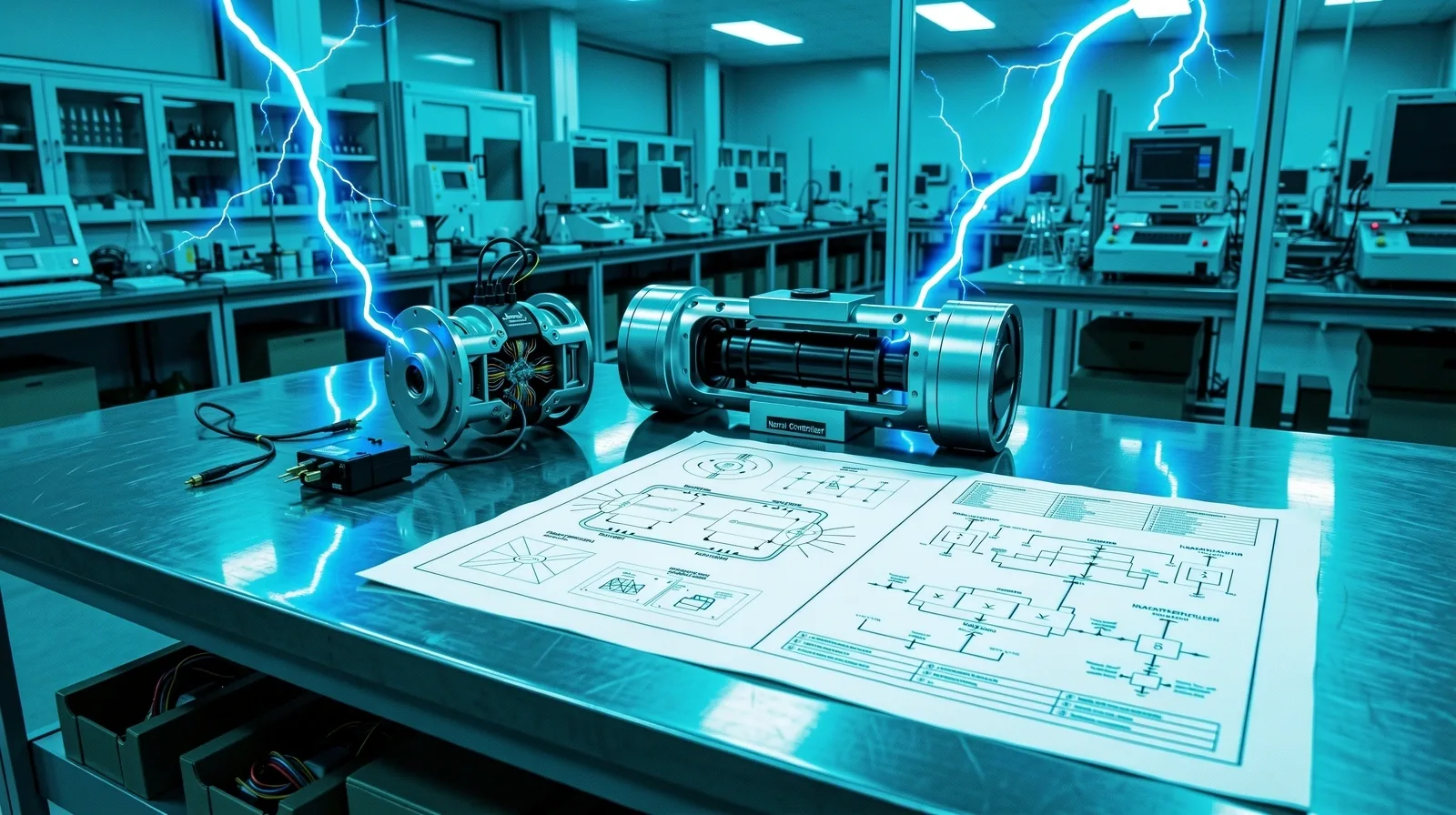
Autonomous sensory hardware array
01_DETECTION_CORE

Reinforcement Learning for High-Density Corridors.

At DealClose Digital, our research is anchored in the mathematical optimization of Markov Decision Processes (MDP). We are currently solving for constrained reward functions that allow autonomous agents to navigate transit corridors with extreme reliability.

CURRENT_PROGRESS_LOG

Multi-agent coordination in high-stress transit environments through synthetic data generation loops.

02_METHODOLOGY_PIPELINE

The Sim-to-Real Transition Architecture.

ARCH_REV: 2026.06.01

01 / Domain Randomization

High-Fidelity Virtual Stress Testing

We subject reinforcement learning agents to millions of permutations in simulated physics. By varying lighting conditions, friction coefficients, and unexpected sensor noise, our models develop a robust "Safe Policy Gradient" that ignores irrelevant environment artifacts.

3D Wireframe simulation
02 / Dynamics Matching

Synchronization of Latency and Force

Bridging the gap requires a perfect match between virtual torque and physical motor response. We implement precise dynamics matching to align simulated acceleration with real-world mechanical constraints.

03 / Physical Deployment

Field Operational Verification

Once an agent reaches 99.9% consistency in the Transfer Lab, it is deployed to hardware. We monitor real-time reward feedback to iterate on observation-action loops in Canadian industrial settings.

  • Sensor Noise Modeling
  • Real-world Feedback Loop
  • Policy Gradient Audit
Neural Network Schematics
FIELD_ANALYSIS_NODE

Solving for the Unpredictable: Sim-to-Real Transfer Logic.

Standard automation relies on fixed decision trees. Our Reinforcement Learning (RL) research focuses on agents that learn to adapt within high-variance environments. By applying constraints directly to the neural objective function, we ensure safety without sacrificing the performance of autonomous decisions.

Core_Methodology Q-Learning Refinement
Safety_Protocol Constrained Policy
Verification_Scope Sim-to-Real Optimization
Region_Compliance Canadian Safety Standards

Laboratory Protocols.

The DealClose approach to Reinforcement Learning is grounded in mathematical control theory. We prioritize algorithmic transparency to ensure every decision made by an autonomous agent can be audited against its training constraints.

01

Environment Mapping & Constraint Design

Before a single line of training code is executed, we define the agent's observation space and operational boundaries. By mapping physical sensor specifications directly into the virtual reward framework, we prevent reward hacking and ensure the learning remains within safe operational limits.

02

Multi-Agent Corridor Coordination

Our research focuses heavily on transit corridors where multiple autonomous units must coordinate without a centralized controller. Using de-centralized policy gradients, each agent learns to respect the trajectory of others while optimizing its own path-finding efficiency.

03

Edge-Case Stress Testing

Sim-to-real lab training includes "Black Swan" scenarios—rare, catastrophic failure modes that would be dangerous to test in the physical world. We force the agent to find safe recovery states under extreme sensor failure or unexpected environmental obstruction.

Advance Your System Intelligence.

Explore how DealClose Digital applies these research findings to industrial and automotive deployments across North America.

Request Lab Notes

Winnipeg HQ: +1-204-551-9727